Tuesday, February 07, 2012

ED slaps PMLA case against Marans - Indian Express

ED slaps PMLA case against Marans
Rahul Tripathi Posted online: Wed Feb 08 2012, 00:45 hrs
New Delhi : The Enforcement Directorate (ED) on Tuesday registered two cases under stringent sections of the Prevention of Money Laundering Act (PMLA) into the multi-crore 2G scam.

The first FIR was registered against former Union telecom minister Dayanidhi Maran and his brother Kalanidhi Maran. It is alleged that the Maran brothers received Rs 550 crore as illegal gratification, punishable under sections of the PMLA and FEMA. Under the provisions of the PMLA, the ED can even attach the properties of Sun TV and the Marans.

The second case pertained to the NDA regime when BJP’s Pramod Mahajan was the telecom minister. The ED has named former telecom secretary Shyamal Ghosh, then deputy director general J R Gupta, Airtel and Vodafone for alleged irregularities in the grant of additional 2G spectrum during 2001-03.

Dayanidhi Maran, who resigned as the Union textile minister after his name cropped up in the 2G scam, is being investigated by the CBI-ED for favouring Malaysian firm Maxis Communication. The ED will now start recording statements under the PMLA before questioning Dayanidhi.

The allegations against Maran brothers were that they allegedly delayed and halted the process of granting a licence to Aircel in 2004-05.

The process of granting licence to Sivashankaran-owned Aircel was reportedly kept pending till an agreement was signed between T Ananda Krishnan-owned Maxis Communication and promoters of Aircel for ownership change in respect to these companies.

An illegal gratification of Rs 550 crore was reportedly accepted through Dayanidhi’s brother Kalanidhi in the garb of share premium invested in M/S Sun Direct TV by South Asia Entertainment holdings Ltd, a fully owned subsidiary of Astro All Asia Networks Plc.

Monday, February 06, 2012

Monday, January 16, 2012

சோழ நாட்டில் பௌத்தம்: July 2011

BUDDHA STATUES IN THE VICINITY OF OTHER TEMPLES IN THE CHOLA COUNTRY*

Dr.B.Jambulingam,
Superintendent,
Tamil University,
Thanjavur 613 010

Buddhism came to Tamil Nadu during the 3rd century BC and it prevailed in the Chola country up to the 16th century AD, which is vouchsafed by an inscription found in Kumbakonam. Buddha viharas were found in many places including Poompuhar and Nagapattinam. The remnant of a vihara is still intact in Poompuhar. Sixty-four Buddha statues were identified in the Chola country comprising of Thanjavur, Nagapattinam, Tiruvarur, Pudukottai, Trichy, Karur, Perambalur and Ariyalur districts during field study undertaken by the author since 1993. Among these 60 statues were in seated posture, and the rest from Cholanmaaligai, Poompuhar, Thiruvalanchuzhi and Sundarapandianpattinam were in standing posture. According to earlier researchers Buddha statues were found at Alangudipatti, Ayyampet, Chettipatti, Kottappadi, Kurumbur, Manganallur, Valikandapuram and Vellanur of Pudukottai. However when the author surveyed these places they could not be located. Probably these statues were lost forever. This highlights the need that these statues have to be protected and preserved by the Government. Several Buddha images are displayed in museums. In the study area Buddha statues are found in Siva temples, village deity temples and Jain temple. Some of them are found in the centre of the town, paddy fields, outskirts of the town or even in the neglected areas. This paper deals with the Buddha statues distributed in and around non-Buddhist temples in the Chola country.

I. Buddha Images from Siva Temples
Buddha statues are found in five Siva temples. They are Ekambaresvarar Kamatchiamman temple (Sundarapandianpattinam), Mathyarjunesvara temple (Pettaivaitthalai), Parsvanathaswami temple (Muzhiaiyur, near Pattisvaram), Sempakaranyesvarar temple (Thirunagesvaram near Kumbakonam) and Siva temple (Thiruvalanchuzhi). There is an inscription in Kumbeswarar temple at Kumbakonam, which speaks about the presence of a Buddha temple in Tiruvilanthurai.

Ekambaresvarar-Kamatchiamman Temple (Sundarapandianpattinam, Pudukottai Dt)
During field study a Buddha statue was found in the Ekambadresvarar Kamatchiamman temple in Sundarapandianpattinam during September 1999. Dr J. Raja Mohamad who identified this Buddha says, “A rare Buddha statue in standing posture has been discovered at Ekambaresvarar Kamatchiamman temple at Sundarapandianpattinam, a coastal hamlet on the border of Pudukottai and Ramanathapuram districts. It is believed that the statue was brought from a ruined, nearly mandapa a structure which bears a resemblance to a Buddhist monastery. The stone idol is similar to the ones found at Nalanda in Bihar, the great Buddhist centre. The Buddha wears a close fitting robe extending from the neck to the legs, in addition to a sangati, covering the back, whose end has elegant folds. The face is oval with the nose, lips, chin and eyes exquisitely chiseled. The earlobe is long, the forehead has a tilak and on the right palm is a diamond-shaped mark-features considered Mahapurushalakshana in Buddhist mythology. The hair on the head is studded knot surmounted with a tapering flame called usnisha indicating the supreme knowledge” (The Hindu: 23.11.2002). This statue is not worshipped now. But it is placed near the sanctum sanctorum of the main deity of the temple. This statue resembles the style of Nagapattinam Buddha bronze.

Mathyarjunesvara Temple (Pettaivaithalai, Trichy Dt)
A Buddha statue, which was found during fieldwork in September 1998 near the rajagopura of the Mathyarjunesvara temple at Pettaivaithalai is now exhibited in the Government Museum, Trichy. This Siva Temple, constructed by Kulothunga III is on the Trichy-Karur road, about 20 km from Trichy. The statue is in padmasana dhyana posture. Local people call this Buddha as ‘Samanar’ which actually refers to a Jain Tirthangara. According to them originally there were three Buddha statues and two of them are lost. The only statue, which was found near Mathyarjunesvara temple, has been shifted and exhibited in the Government Museum at Trichy in May 2002 (Dinamalar: 17.5.2002).

Parsvanathaswami Temple
(Muzhaiyur, Thanjavur Dt)
At the Parsvanathaswami temple in Muzhaiyur, near Pattisvaram, in Kumbakonam taluk a head of Buddha statue was found during field study in June 1999. One of the ears of this Buddha , whose face has a gracious smile, is found broken. Curled hair and usnisha are perfectly carved. This is not under worship.

Sempakaranyesvarar Temple
(Thirunagesvaram, Thanjavur Dt)
Two Buddha images were found in the prakara of the Amman shrine of the Sempakaranyesvarar temple at Thirunagesvaram near Kumbakonam in Thanjavur district during field work. These images are in sitting posture and they are not under worship. Even though the workmanship of these statues is not so good, the presence of these statues confirms the existence of Buddhism in this area. Very near to this place is an area called ‘Channapuram’ (Jainapuram). Based on this place name and the similarities of the Buddha statues with the Jain images it can be suggested that this place might have been a Jain centre.

Thiruvalanchuzhi Siva Temple
(Thiruvalanchuzhi, Thanjavur Dt)
There was a Buddha statue in the Siva Temple of Thiruvalanchuzhi in Thanjavur District (1957: 103). “The prominent but delicately carved features the exceedingly proportionate modelling and the tastefully worked drapery made this figure as one of the masterpieces of sculpture belonging to the end of the early Chola period. A noteworthy detail of this figure is its urna, which is shown not as the usual prominent circular dot on the forehead but simply outlined as an inverted question mark in the fashion of a number of bronze images from Nagapattinam. The urna and other details show the close correspondence between a metal image and a stone figure of the same period and locality. It also does not have a halo. In general, the features of the figure show that the sculptor who produced this was still imbued with the artistic tradition of earlier periods” (1960: 94). This statue is now exhibited in the Government Museum, Chennai.

Kumbesvarar Temple (Kumbakonam, Thanjavur Dt)
While other temples discussed above have Buddha statues, the Kumbesvarar temple at Kumbakonam in Thanjavur district has an inscription referring to the existence of Buddha temple . It is found on the doorjamb of the entrance of the inner prakara of the temple. This temple has the credit of possessing the inscription on survival of Buddhism as late as the 16th century A.D. (1999: 93). It mentions about one Titta Mamarunta Nayakar of the Buddha temple at Tiruvilanthurai, a small village near Tirunagesvaram-Tiruneelakkudi on the Kumbakonam-Karaikkal highway, during 1580 A.D. (EI, Vol XIX: 215-217). The text of the inscription is reproduced below:
(On) the 22nd day of the month of Adi in the year Vikrama, all the people of Tirumalairajapuram assigned 2¾ (veli of) land in the Brahman village (agaram) of Tirumalairajapuram for repairs as a charity of Sevappa Nayakkar-ayyan as the channel was dug and passed through the land belonging to ‘Titta Mamarunda-Nayar of the Buddha Temple’ at Tiruvilandurai.
From the above inscription it is understood that for digging the canal at the land belonging to the Buddha temple of Titta Mamarunda Nayar, compensation was made. From it one can infer about the presence of Buddha temple around 16th century A.D. Even though there are no remains of the Buddha temple at Tiruvilanthurai now, this inscription confirms the existence of Buddhism till that period. It is the only inscription from a Siva temple in the Chola country that speaks about a Buddha temple.

II. Buddha Images from Village Deity Temples
Buddha statues are found in the village deity temples such as Aravandi Amman temple (Mangalam, near Musiri), Muthumariamman temple (Pattisvaram, Thanjavur district) and Nilavalamudaya Ayyanar temple (Karur near Ponpatri).

Aravandi Amman Temple (Mangalam, Trichy Dt)
In Mangalam of Tiruchy district, 15 km from Musiri, there is an Aravandi Amman temple. The author with the help of K.Sridharan identified a Buddha statue in the temple in May 1998. According to K.Sridharan, “The locals have been worshipping the statue of Buddha along with the deity Aravandi Amman. The bottom portion of the peetam of the statue has three lions in sitting posture. The statue is in padmasana dhyana posture and the face, the broad shoulders, the long arms and the palms one resting on the other is an example of the high degree of workmanship achieved during the Chola period. The face exemplifies the blessed state of the mind during dhyana, and the long earlobes, the typical head gear, and the hair arranged in a bunch at the top portion, give a special grandeur thanks to the backdrop of granite tiruvasi like constructions at the rear. This statue belongs to 10th century” (The Hindu: 8.5.1998). The special feature of this statue is the presence of moustache (Dina Malar: 17.6.1999). Nowhere in the Chola country Buddha statue with moustache is found. It is to be noted that no other Buddha statue of this area has lions on the seat. According to the villagers since Buddha was against sacrifice, they constructed a separate shrine there away from the folk deity. They call the Buddha image as 'Chettiar’.

Muthumariamman Temple
(Pattisvaram, Thanjavur Dt)
Near Pattisvaram on the Pattisvaram-Govindakkudi road is a temple dedicated to Muthumariamman is found. A Buddha statue was found during field study in October 1998 in this temple. The Buddha image in seated posture is installed along with other folk deities (1957: 45).Even though the local people do not know that the image represents the Buddha, they offer worship. This is one of the smallest Buddha statues found in the Chola country.

Nilavalamudaya Ayyanar Temple
(Karur, Pudukottai Dt)
A Buddha image is found during the fieldwork undertaken in September 1999 at Nilavalamudaya Ayyanar temple in Karur, which is five miles to west of Ponpatri in Arantangi Taluk in Pudukottai district. From the iconographical aspects it appears to belong to the Chola period (1992: 249). This is a small but beautiful figure seated in the usual dhyana posture. “It has around it, the prabha on pillars. The other features of it are unmistakably in the late Chola period. It must be noted that Karur is very near to Ponpatri, the birthplace of the famous Buddhamitra who lived in the 11th century A.D. He wrote Veerasoliyam during the rule of the Chola king Veera Rajendra. The existence of this image in a nearby village, the reported existence of images of this kind in several villages in the neighbourhood, and the late Chola style of this image, all go to show that Buddhism was undoubtedly in a flourishing condition in this area during the Chola times” (1960: 99). The local people offer sacrifice to the village deity Karuppasamy which is in the vicinity of the temple. To avoid the Buddha seeing this offering, the villagers have installed the Buddha statue separately. Alongwith other deities, Buddha is worshipped here.

III. Buddha Image from Mallinatha Jain Temple
(Mannargudi, Tiruvarur)
A Buddha statue was found in the Jain temple at Mannargudi during field study in August 1998. In the Chola country Jain temples are found in Thanjavur, Kumbakonam, Deepanakudi and Mannargudi. The Jain temple at Mannargudi has a Buddha statue, in its northern prakara under the shade of a tree. This is in sitting dhyana pose with beautiful workmanship. Like some of the Nagapattinam Buddha bronze images, this statue has one attendant each on either side (1979: 115). Local people worship this Buddha.

IV. Discussion
Even after the impact of the bhakti movement, Buddhism continued to survive in certain areas of Tamil Nadu during Chola period. The statues found in the Chola country attest to this fact. Many Buddha statues found in this area belong to the 9th century A.D. to the 11th century A.D. Without the presence of Buddhist temples or viharas there would not have been so many Buddha images in this area in the vicinity of the temples. In order to protect the Buddha statues the local people have placed them in the nearby non-Buddhist temples. Buddha is worshipped, as any other deity, in many places. This shows the people treat Buddha equal to the deities that they worship.
*Published in Tamil Civilization, Vol.19, September 2008, Tamil University, Thanjavur,Tamil Nadu, India.


Reference
Dinamalar (Tamil Daily), dated 17th May 2002
Dinamani (Tamil Daily), dated 18th July 1999
Dinathanthi (Tamil Daily), dated 3rd February 2004
Dinamani (Tamil Daily), dated 11th August 2006
Epigraphia Indica, Vol. XIX, pp.215-217
The Hindu dated 8th May 1998
The Hindu dated 23rd November 2002
The Hindu dated 27th June 2006
Jambulingam, B., Buddhism in Tamilnadu with special reference to Thanjavur District, M.Phil., Dissertation, Madurai Kamaraj University, Madurai, 1995
…………………, Chola Nattil Boutam, (Tamil) Ph.D, Thesis, Tamil University, Thanjavur, 1999
…………………, Buddhism in the Cola Country, Project Report, Nehru Trust for the Indian Collections at the Victoria & Albert Museum, New Delhi, 2002
Kudavayil Balasubramanian, Thanjavur Nayakkar Varalaru (Tamil), Thanjavur Maharaja Serfojiyin Saraswathi Mahal Noolagam, Thanjavur, 1999
Minakshi, C., “Buddhism in South India”, South Indian Studies-II, (Editor R.Nagaswamy), Society for Archaeological, Historical and Epigraphical Research, Chennai, 1979
The New Indian Express dated 10th July 1999
Raja Mohamad, J., Pudukottai Mavatta Varalaru (Tamil), Collector, Pudukottai, 1992
Srinivasan, P.R., “Buddhist images of South India”, Story of Buddhism with special reference to South India, Department of Information and Publicity, Madras, 1960
Vasudeva Rao, T.N., Buddhism in the Tamil country, Annamalai University, Annamalainagar, 1979
Venkatasamy, Mayilai Seeni., Bouthamum Tamilum, (Tamil) Thirunelveli Then India Saiva Siddhantha Noorppathippukkalagam, Chennai, 1957

(updated on 24.12.2011)

Tuesday, January 10, 2012

The dangers of demonology

Schumpeter

The dangers of demonology

Hatred of bankers is one of the world’s oldest and most dangerous prejudices

HURLING brickbats at bankers is a popular pastime. The “Occupy Wall Street” movement and its various offshoots complain that a malign 1%, many of them bankers, are ripping off the virtuous 99%. Hollywood has vilified financiers in “Wall Street”, “Wall Street 2”, “Too Big to Fail” and “Margin Call”. Mountains of books make the same point without using Michael Douglas.

Anger is understandable. The financial crisis of 2007-08 has produced the deepest recession since the 1930s. Most of the financiers at the heart of it have got off scot-free. The biggest banks are bigger than ever. Bonuses are flowing once again. The old saw about bankers—that they believe in capitalism when it comes to pocketing the profits and socialism when it comes to paying for the losses—is too true for comfort.

But is the backlash in danger of going too far? Could fair criticism warp into ugly prejudice? And could ugly prejudice produce prosperity-destroying policies? A glance at history suggests that we should be nervous.

Scorn for moneymen has a long pedigree. Jesus expelled the moneychangers from the Temple. Timothy tells us that “the love of money is the root of all evil.” Muhammad banned usury. The Jews referred to interest as neshek—a bite. The Catholic church banned it in 1311. Dante consigned moneylenders to the seventh circle of hell—the one also populated by the inhabitants of Sodom and “other practisers of unnatural vice”.

For centuries the hatred of moneylending—of money begetting more money—went hand in hand with a hatred of rootlessness. Cosmopolitan moneylenders were harder to tax than immobile landowners, governments grumbled. In a diatribe against the Rothschilds, Heinrich Heine, a German poet, fumed that money “is more fluid than water and less steady than air.”

This prejudice has proven dangerous. Without money to grease them, the wheels of commerce turn slowly or not at all. Civilisations that have eased the ban on moneylending have grown rich. Those that have retained it have stagnated. Northern Italy boomed in the 15th century when the Medicis and other banking families found ways to bend the rules. Economic leadership passed to Protestant Europe when Luther and Calvin made moneylending acceptable. As Europe pulled ahead, the usury-banning Islamic world remained mired in poverty. In 1000 western Europe’s share of global GDP was 11.1% compared with the Middle East’s 8.6%. By 1700 western Europe had a 13.5% share compared with the Middle East’s 3.4%.

The rise of banking has often been accompanied by a flowering of civilisation. Artists and academics railing against the “agents of the Apocalypse” might also learn from history. Great financial centres have often been great artistic centres—from Florence in the Renaissance to Amsterdam in the 17th century to London and New York today. Countries that have chased away the moneylenders have been artistic deserts. Where would New York’s SoHo be without Wall Street? Or the great American universities without the flow of gold into their coffers?

Prejudice against financiers can cause non-economic damage, too. Throughout history, moneylenders have been persecuted. Ethnic minorities—most obviously the Jews in Europe and America but also the Chinese in Asia—have clustered in the financial sector first because they were barred from more “respectable” pursuits and later because success begets success. At times, anti-banking prejudice has acquired a strong tinge of ethnic hatred.

In medieval Europe Jews were persecuted not only because they were not Christians but also because killing them was a quick way to expunge debts. Karl Marx, who came from a Jewish family, regarded Jews as the embodiments of capitalism who could only be rescued from their ancestral curse through revolution. The forgers of the “Protocols of the Learned Elders of Zion” wanted people to believe that Jewish financiers were engaged in a fiendish global conspiracy. Louis McFadden, the chairman of the United States House Committee on Banking and Currency in the 1930s, claimed that “the Gentiles have the slips of paper while the Jews have the lawful money.” The same canards have been used against Chinese minorities across Asia.

This is not to say that the Occupy protesters are guilty of ethnic prejudice: they belong to a class and a generation that is largely free from such vices. But demonisation can easily mutate into new forms. In the August issue of the Journal of Business Ethics one Clive Boddy argues that the financial sector has been taken over by psychopaths: “people who, perhaps due to physical factors to do with abnormal brain connectivity and chemistry”, lack a “conscience, have few emotions and display an inability to have any feelings of sympathy or empathy for other people”.

Caged emotions

Railing against the 1%—particularly when so many of them work for companies with names like Goldman Sachs and N.M. Rothschild—can unleash emotions that are difficult to cage. A survey in the Boston Review in 2009 found that 25% of non-Jewish Americans blamed Jews for the financial crisis, with a higher percentage among Democrats than Republicans. Ethnic hatreds are even rawer in parts of Asia. The Asian financial crisis of 1997-98 sparked murderous riots against rich Chinese in places such as Indonesia. Today, the combination of hard times and harsh rhetoric could also produce something nasty.

The crisis of 2008 showed that global finance requires tough medicine. Banks must be forced to hold bigger reserves. “Weapons of mass destruction” must be defused. The culture of short-term incentives needs to be revised. But demonising bankers will not solve these problems—and may well, if unchecked, bring a lot of ancient ugliness back to life.

Wednesday, December 28, 2011

History of Quit India, Nehru & CPI split

HISTORY Of Quit India, Nehru & CPI split

A.G. NOORANI

Stalin upbraided CPI leaders for not supporting the Congress on the Quit
India Movement.


OF all the Communist leaders interviewed in the Oral History
Programme of the Nehru Memorial Museum & Library in New Delhi,
Makineni Basavapunniah was the most outspoken. The armed struggle in
Telangana, which began in 1946, was directed against the Nizam's
government. But ?from September 1948 onwards it was regular armed
invasion. It was not a police action. Either the special armed police or
the Malabar Police or the army, nearly 50,000 were employed for three
full years to suppress the movement. Indian Army was not more than one
and a half lakh or two lakhs in those days. A good part of it was locked
up in Kashmir. Other part had to remain somewhere stationary. Then to
spare as nearly 40,000-50,000 armed forces at one spot was not a small
thing. So they concentrated their best and did their worst. Ten thousand
people were put as detenus for three-four years; nearly a lakh of
people were put in concentration camps for months on end; thousands of
women were raped.? Dr Hari Dev Sharma asked: ?By the military??
Basavapunniah replied: ?Of course, military and the other armed forces,
like Central Reserve Police, Malabar Police, Special Police, like that
so many.?
He added: ?Particularly after September 1948 when the Government of
India intervened, as I said earlier, it intervened with very big armed
forces. The entire modern military technique was used against us.
General J.N. Chaudhuri, who intervened there on behalf of the Government
of India, took hardly half a dozen days to manage the army of the Nizam
and the Razakars, etc. After that the main direction was against the
Communist Party which was leading the struggle.?
He explained why he developed reservations over the Ranadive thesis
adopted by the Second Party Congress at Calcutta in February 1948.
Experience in Telangana flew against the thesis. ?The Andhra document
was submitted in the month of May 1948. The Politburo was keeping its
discussions confined to it till the month of November 1948. So it was
only in the month of November and December 1948 that this reached all
the State units. The whole of the year 1949, there was an inner party
discussion going on. By March 1950 the whole cycle was complete and the
line that was adopted at Calcutta was proved wrong and we were asked to
take the responsibility of the Central Committee leadership. Then came
the question of going and meeting Stalin, and then working out all the
lines.? The Communist Party of India unit in Andhra disagreed with the
leadership. In the earlier articles, we have Basavapunniah's account of
the Moscow meeting, which was arranged to avert a split.
Like his colleagues, P. Sundarayya also dilated on the alliance with
the Congress Socialist Party in the 1930s and how the Kerala, Andhra and
Madras units of the CSP went over to the CPI. Conflict was inherent in
the alliance. ?Right from the beginning, from 1934 itself, this conflict
had been there. Because in the earlier period, some of our writings
[aid] that Congress Socialism was contradictory in words and would pave
way to fascism. Such kind of articles were written. The [Congress]
Socialist Party leadership also attacked [saying] that the communists
were responsible for fascism coming in Germany by not having a united
front. They had their own ideology; Gandhian ideology also influenced [
sic] that the communists were anti-national. They also used to say all
these things?. Similarly, Sajjad Zaheer, Dr K.M. Ashraf, Dr Z.A. Ahmed,
[Soli] Batliwala were all big Congress leaders; they were all leftists
and were in the Congress Socialist Party. They were all pro
[communists]; some of them were party members also.? So, this struggle
went on till they found that they could not function in a united way.
Then they decided to remove us and we also found that it was difficult
to convince a good chunk of them. We had to function more and more
independently than through the Congress Socialist party. That phase came
towards the end of 1938.?

Dange's role
Sadly, S.A. Dange's recorded Interview ends abruptly before the
crises of the 1940s. He was a fascinating character, a brilliant
pamphleteer, orator and a supple tactician. He was known to be close to
the mill owner Sir David Sassoon. On March 7, 1964, Current, a Bombay
[now Mumbai] tabloid, edited by D.F. Karaka, published a letter from
Dange to the Governor-General of India dated July 28, 1924, from Sitapur
jail in the United Provinces (U.P.) where he was serving a four-year
sentence in the Kanpur Conspiracy Case.
It said: ?Exactly one year back, the Deputy Commissioner of Police of
Bombay, Mr Stewart, was having a conversation with me, in his office
regarding my relations with M.N. Roy and an anticipated visit to me of
certain persons from abroad. During the course of the conversation the
Honourable officer let drop a hint in the following words, the full
import of which I failed to catch at that moment. Mr Stewart said, ?You
hold an exceptionally influential position in certain circles here and
abroad. Government would be glad if this position would be of some use
to them.' I think I still hold that position. Rather it has been
enhanced by the prosecution. If Your Excellency is pleased to think that
I should use that position for the good of Your Excellency's government
and the country, I should be glad to do so, if I am given the
opportunity by Your Excellency granting my prayer for release.


THE HINDU ARCHIVES

S.A. DANGE. HE was a member of the Communist delegation that met Stalin
in Moscow. Here, he is giving a talk on "My visit to Russia" in the
weekly BBC Marathi magazine programme "Radio Jhankar". The others in the
delegation were Ajoy Ghosh, M. Basavapunniah and C. Rajeswara Rao.


?I am given the punishment of four years' rigorous imprisonment in
order that those years may bring a salutary change in my attitude
towards the King Emperor's sovereignty in India. I beg to inform Your
Excellency that those years are unnecessary, as I have never been
positively disloyal towards His Majesty in my writings or speeches nor
do I intend to be so in future.
?Hoping this respectful undertaking will satisfy and move Your Excellency to grant my prayer and awaiting anxiously a reply.
I beg to remain,
Your Excellency's Most
Obedient Servant,
Shripat Amrit Dange.
Written this day 28th July, 1924
Endorsement No. 1048, dated 31-7-1924.
Forwarded in original to I.G. [Inspector General] of prisons U.P. for disposal.
Sd/- W.P. Cook
Col. I.M.S.
Superintendent of Jail.
Seal of I.G. Prisons
13070 Dated 1-8-1924.?
On March 16, Basavapunniah and P. Ramamurthi went to the National
Archives in New Delhi and again on March 17 and 19. What they found was
set out in a pamphlet published by the Communist Party of India
(Marxist) after the split later in the year. It was entitled Dange
Unmasked (for a detailed analysis of the texts of the documents,
including comments by the formidable Lt Col Cecil Kaye, Director of the
Intelligence Bureau, perhaps its most able ? ?he is personally, a mere
worm? ? vide the writer's article ?Dange Letters?; Survey (London)
Spring 1979; pages 160-174).
Years later I sought an interview with Dange. What he said of the
famous meeting with Stalin rang true. Stalin upbraided the CPI leaders
for not supporting the Congress on the Quit India Movement when they
mentioned that their stand had cost them dear. ?Why didn't you support
it? Do you think we won the war because of the 100 rifles you sent us??
Stalin was informality itself. Dange sat on the armrest of his chair
when Stalin pored over the map of India he had sent for. ?Is this your
Yenan?? he asked with unconcealed contempt. It lay at the very heart of
India. What followed the meetings is well recorded but not completely in
a single volume.
Significantly, later Soviet writers also criticised the CPI's 1942
decision. Dr Alexander I. Chicherov, Head of the International Relations
Research Department and Institute of Oriental Studies, Academy of
Sciences USSR in Moscow, was an erudite scholar. He found in the
archives a letter from Bal Gangadhar Tilak to the Russian Consulate in
Bombay in 1905 outlining his plans for intensifying the freedom
struggle. He admired Tilak.
On a visit to Bombay, Chicherov told Indian Express that the CPI's
decision to keep out of the Quit India Movement was ?tragic? (October
15, 1982).
One question arises. One of the interviewers said that they had no
direct contact with Moscow, only with the Communist Party of Great
Britain, that is, with Rajani Palme Dutt and Harry Pollit. Was it Palme
Dutt, then, who instructed the switch in 1942?
Basavapunniah's interview mentions the disagreement between the
Andhra thesis and the thesis of the Central leadership. The party was on
the verge of a split. It was averted by Stalin. Like Dange, Mohit Sen
supported the Emergency. Both left the CPI, But Mohit Sen's memoir is of
absorbing interest. Sadly, it did not receive the review it deserved ( A
Traveller and the Road: The Journey of an Indian Communist; Rupa &
Co.; 2003). The two remained close.
Mohit Sen's account
Mohit Sen wrote: ?I was to have the privilege of carrying the ?China
path' document to China. The CPI leadership hoped and expected that the
leadership of the CPC would endorse this understanding and back it....
?At that time, I did not know that this line had been challenged by
an important section of the CPI leadership headed by Ajoy Ghosh, S.A.
Dange and S.V. Ghate. They had produced a joint document which had gone
down in the history of the party as the ?Three Ps' document?.
?This document shared the viewpoint that India had not won
independence and that the Nehru government upheld the interests of
British imperialism, landlords and those sections of the bourgeoisie
that collaborated with imperialism. The document also held the view that
armed revolution was the only path of advance. It differed from both
the Ranadive line and the China path line [ the Andhra thesis] on its
insistence that Indian conditions differed in the 1950s from both Russia
and China. The strategy of the CPI should, therefore, be that of the
Indian path. The armed revolution in our country would be a combination
of peasant guerrilla actions in the countryside with working class
insurrections in the urban areas. This was an updated version of what
S.A. Dange had advocated decades ago in Gandhi vs. Lenin published in
1920, which had caught the attention of Lenin himself.


RAJEEV BHATT

MOHIT SEN. HE wrote: "I was to have the privilege of carrying the `China
path' document to China."

?The other point of difference of ?the three Ps' document was its
realistic appraisal of the actual situation of the CPI. It was on the
verge of annihilation. Its mass organisations were shattered and the
party itself almost totally disintegrated. The first task was to save
the party itself and to reforge its ties with the masses, taking into
account the existing civil liberties.
?The proponents of the ?Chinese path' led by Comrade C. Rajeswara Rao
and those of the ?Indian path' led by Comrade Ajoy Ghosh had set up
their own centres and the CPI was on the verge of a split. It was then
that the Soviet Communists intervened.
?Four leaders, two from each centre, were brought to Moscow. They
travelled, incognito as manual workers on a Soviet ship from Calcutta.
They were Comrades Ajoy Ghosh, S.A. Dange, C. Rajeswara Rao and M.
Basavapunniah. None of them divulged any details of how they were
contacted and what their exact itinerary was. Nikhil Chakravartty, who
attended to all the technical details of planning the journey, has also
not said anything.

BY SPECIAL ARRANGEMENT

A GROUP OF Telangana fighters. "[Stalin] strongly advised that the armed
struggle being conducted in various areas, especially the Telangana
region of Andhra Pradesh, should be ended."

?S.A. Dange and C. Rajeswara Rao have both told me about the meeting
with the leaders of the CPSU [Communist Party of the Soviet Union]. The
first meeting was attended from the Soviet side by Comrades [Mikhail
Andreyevich] Suslov, [Georgy] Malenkov and [Vyacheslav Mikhailovich]
Molotov. It was on the third day that it was announced that Comrade
Stalin would attend. So he did for the subsequent days. Dange and
Rajeswara Rao said that he was an attentive listener though he rarely
sat at the table but kept pacing up and down smoking a pipe. But he
intervened subtly to turn the discussion beyond dogmatic disputes to
assessments of the existing situation and immediate tactical tasks.
Stalin's view on Nehru government
?Stalin's view also was that India was not an independent country but
ruled indirectly by British colonialists. He also agreed that the
Communists could eventually advance only by heading an armed revolution.
But it would not be of the Chinese type. His view on this point
coincided with that of ?the three Ps'. He also agreed with their
appraisal of the concrete situation in which the party was placed. He
strongly advised that the armed struggle being conducted in various
areas, especially the Telangana region of Andhra Pradesh, should be
ended. He said that it was Comrade Rajeswara Rao who should travel to
the different camps and see that the arms were surrendered. This would
be difficult but it was he alone who could do it. That, in fact, was
done and Rajeswara Rao later told me that this was the most difficult
task he had ever performed for the party.
?Stalin also cautioned the CPI leaders that the Nehru government was
not a puppet government. It had a social base and mass support and could
not be overthrown easily. He asked the leaders to unite, work together,
save the party and take it forward. He strongly advised them to make
the CPI participate in the general elections? (pages 80-81).


BY SPECIAL ARRANGEMENT


P. SUNDARAYYA AND (below) Basavapunniah in the 1950s.


The record has him say: ?I cannot consider the government of Nehru as
a puppet. All his roots are in the people.? He was polite to the
visitors, but they did not win his respect. His interpreter and the
diplomat Nikolai Adyrkhayev's memoirs, released on Stalin's 118th birth
anniversary (December 21, 1879), reveal that later in the year Stalin
scolded a delegation of the Japanese Communist Party: ?In India they
have wrecked the party and there is something similar with you.?

BY SPECIAL ARRANGEMENT

As it happens some interesting documents have surfaced in the pages
of a journal, Revolutionary Democracy, published by Vijay Singh. The
issue of April 2011 published documents from the papers of Rajani Palme
Dutt in the archives of the Communist Party of Great Britain, which are
deposited in the Labour Archive and Library, Manchester.

BY SPECIAL ARRANGEMENT

THE NINE MEMBERS of the first Polit Bureau of the Communist Party of
India (Marxist) after the 1964 split in the Communist movement:
(standing, from left) P. Ramamurthi, Basavapunniah, E.M.S. Namboodiripad
and Harkishan Singh Surjeet; (sitting, from left) Promode Dasgupta,
Jyoti Basu, Sundarayya, B.T. Ranadive and A.K. Gopalan.

One was a letter dated November 1, 1962, from B.N. Datar, Minister of
State for Home, to P.K. Sawant, Home Minister, Maharashtra. It read :
?I am enclosing herewith in original a list handed over personally by
Shri S.A. Dange, to Home Minister recently giving the names and
addresses of CPI persons in Bombay and other individuals who in the
opinion of Shri S.A. Dange are pro-Chinese. I would request your
immediate comments and action in the matter under advice to me.? The
other letter contains charges too scandalous to be reproduced, still
less vouched for.

Authentic material on Moscow talks

Three other issues contain authentic material on the Moscow talks
from the Russian State Archive of Social and Political History
translated from the Russian by Vijay Singh. There is a stenographic
record of the discussions between the two delegations on February 4, 6
and 9, 1951 (September 2006; pages 162-200). As one might expect, the
Indians did most of the talking on the first two days, explaining
internal differences and replying to pointed questions by the hosts.
Stalin spoke at great length on February 9 (pages 186-200).
The issue of April 2007 published a record of the discussions with
Malenkov and Suslov on February 21 (pages 126-130). The issue of April
2010 has three letters by the CPI leaders; Stalin underlined parts of
the letters and gave his comments in the margin. All these documents
merit detailed analysis in the light of the CPI's internal debates in
1948-51.

Postscript: Aloke Banerjee of Hindustan Times reported from Kolkata
on November 26, 2005: ?Marxist Patriarch Jyoti Basu had been against a
split in the CPI and had urged all his comrades to keep the party
united. This was in 1963, a year before some CPI leaders left the party
and formed the CPI(M).

?Documents portraying the final days before the CPI split have been
made public with the CPI(M) publishing the fourth volume of Communist
Movement in Bengal: Documents and Related Facts. The book contains a
letter Basu wrote from the Dum Dum Jail on October 9, 1963, titled ?Save
the party from revisionists and dogmatic extremists'. ?We must stay
within the party and continue our ideological struggle against Dange's
revisionism. It will not be right to split the party,' Basu had said in
the letter. ?Yet, the reckless dogmatists seem to be determined to break
up the party.'

?Four decades on, Basu cannot remember having written such a letter.
Informed that his party had published his letter, Basu told HT on
Friday, ?I don't remember having written such a letter. But it's true
that I had tried till the last moments to stop the imminent split. I was
of the opinion that it would be incorrect to break the CPI and form a
new party. But I failed. There were many differences. We could not stay
together any longer.' The CPI(M)'s book also contains the minutes of a
crucial meeting of the party's working committee.? Unfortunately, the
book is in Bengali. An English translation is overdue.
______________________________


HUMANITIES Magazine: November/December 2011: The Islamic Scholar Who Gave Us Modern Philosophy

Monday, December 12, 2011

Wednesday, December 07, 2011

Bengal Famine

Bengal Famine


Churchill’s Man-Made Famine

Death Toll: 4,000,000

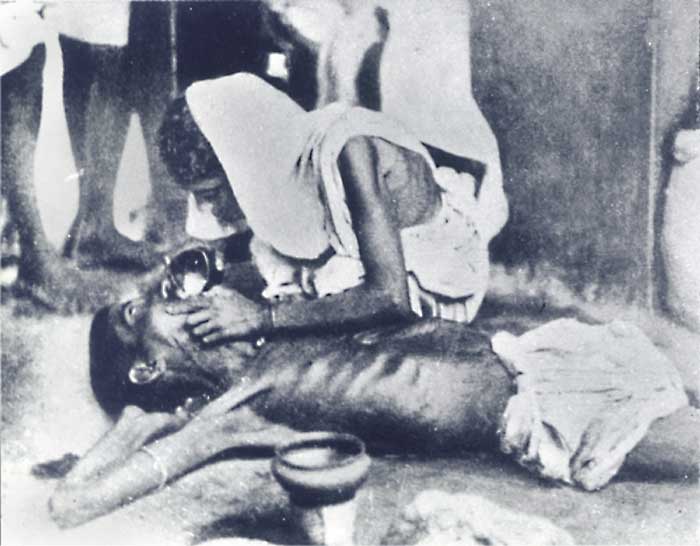
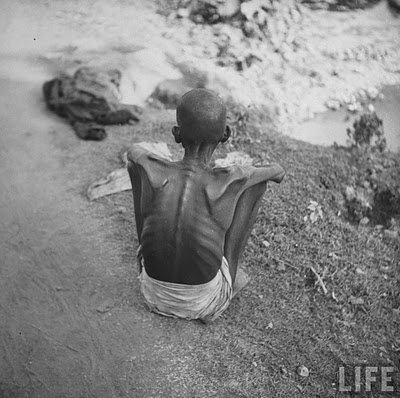
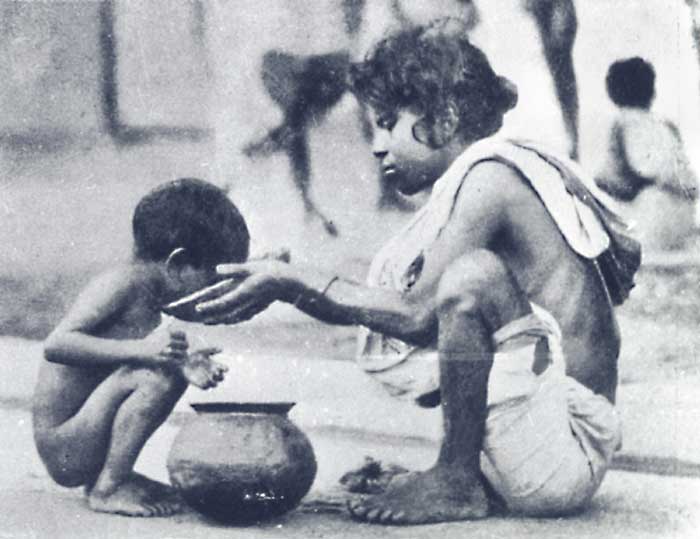
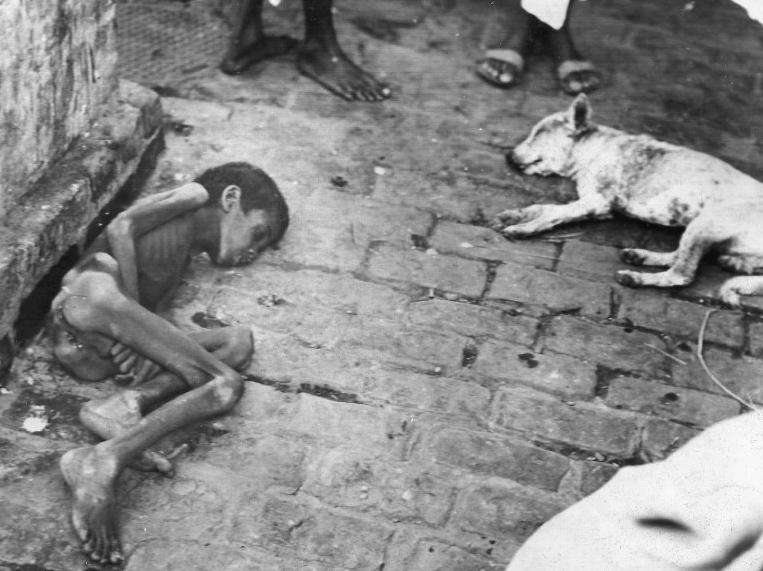
This Forgotten holocaust committed by British imperialism was caused by the diversion of shipping normally used to bring food to Bengal. The shipping was used instead to bring military supplies to the British army in North Africa in 1942.

According to Dr. Gideon Polya, a professor in Victoria, Australian, the 1943-44 famine that killed an estimated 3.5 to 5 million people in Bengal was “man-made”. Dr. Polya says that “the British brought an unsympathetic and ruthless economic agenda to India” and that “the creation of famine” was brought about by British “sequestration and export of food for enhanced commercial gain.”

He says that “British disinclination to respond with urgency and vigor to food deficits resulted in a succession of about 2 dozen appalling famines during the British occupation of India.” These swept away tens of millions of people. One of the worst famines was that of 1770 that killed an estimated 10 million people in Bengal (one third of the population) and which was “exacerbated by the rapacity of the (British) East India Company”.

Dr. Polya writes that “An extraordinary feature of the appalling record of British imperialism with respect to genocide and mass, world-wide killing of huge numbers of people (by war disease and famine) is its absence from public perception. Thus, for example, inspection of a selection of British history texts reveals that mention of the appalling Irish Famine of 1845-47 is confined in each case to several lines (although there is of course detailed discussion of the attendant, related political debate about the Corn Laws). It is hardly surprising that there should be no mention of famine in India or Bengal.”

How Destructive Was Colonialism to India?

Colonial era (1765–1947)
Great Bengal Famine  1769–1770      10,000,000
Madras city famine     1782–1783    Unknown
Chalisa famine            1791–1792      11,000,000
Doji bara or Skull famine        1789–1795      11,000,000
Agra famine of 1837–38         1837–1838      800,000
Eastern Rajputana       1860–1861      2,000,000
Orissa famine of 1866 1865–1867      1,000,000
Rajputana famine of 1869      1868–1870      1,500,000
Bihar famine of 1873–74        1873–1874      Unknown
Great Famine of 1876–78       1876–1878      10,300,000
Orissa, Bihar   1888–1889      150,000
Indian famine of 1896–97      1896–1897      5,000,000
Indian famine of 1899–1900  1899–1900      1,000,000
Bombay Presidency    1905–1906      230,000
Bengal famine of 1943           1943–1944      5,000,000
Independent India
Bihar famine of 1966-67         1966–1977   Unknown

Winston Churchill blamed for 1m deaths in India famine

Sir Winston Churchill may be one of Britain’s greatest wartime leaders, but in India he has been blamed for allowing more than a million people to die of starvation.

Dean Nelson in New Delhi
According to a new book on the famine, Sir Winston ignored pleas for emergency food aid for millions in Bengal left to starve as their rice paddies were turned over to jute for sandbag production and supplies of rice from Burma stopped after Japanese occupation.
Between one and three million died of hunger in 1943.
The wartime leader said Britain could not spare the ships to transport emergency supplies as the streets of Calcutta filled with emaciated villagers from the surrounding countryside, but author Madhusree Mukerjee has unearthed new documents which challenge his claim.
In her book, Churchill’s Secret War, she cites ministry records and personal papers which reveal ships carrying cereals from Australia were bypassed India on their way to the Mediterranean where supplies were already abundant.
“It wasn’t a question of Churchill being inept: sending relief to Bengal was raised repeatedly and he and his close associates thwarted every effort,” the author said.
“The United States and Australia offered to send help but couldn’t because the war cabinet was not willing to release ships. And when the US offered to send grain on its own ships, that offer was not followed up by the British,” she added.
The man-made famine and the contrast between the plight of starving Indians and well-fed British officers dining in the city’s many colonial clubs has been described as one of the darkest chapters in British rule on the Indian subcontinent.
Miss Mukerjee blames Churchill’s ‘racism’ for his refusal to intervene.
He derided Gandhi as a “half-naked holy man” and once said: “I hate Indians. They are a beastly people with a beastly religion.”
He was known to favour Islam over Hinduism.
“Winston’s racist hatred was due to his loving the empire in the way a jealous husband loves his trophy wife: he would rather destroy it than let it go,” said Miss Mukerjee.

Monday, December 05, 2011

The Hindu : States / Andhra Pradesh : Vote for no trust motion, T-Congress MLAs urged

The Hindu : States / Andhra Pradesh : Vote for no trust motion, T-Congress MLAs urged

Scores of Telangana Rashtra Samithi (TRS) workers and its students' wing members took out a motorcycle rally from Warangal railway station to Kazipet railway station demanding Telangana Congress leaders to vote in favour of no-confidence motion.

The TRS wanted the Telangana Congress MLAs to pull down the State government by supporting the no confidence motion moved by the TDP, as the Congress failed to keep up its promise of giving separate Telangana State.

The rally was led by former MLA T. Rajaiah, a former Congress MLA who recently joined the TRS and resigned for his Assembly membership. Hundreds of students of Kakatiya University and other private educational institutions took part.

The Students JAC leaders said they would take the responsibility of ensuring the victory of all the Telangana Congress MLAs if they brought down the government. “We will go door-to-door and see that all those MLAs who resigned for the cause of separate Telangana are elected,” said K. Vasudeva Reddy and others.

The students said those who do not support the cause of separate Telangana would have to face the ire of people. They said they would not allow the Congress MLAs to move in villages if they failed to utilise the opportunity to bring down the government that went back on its promise of creating separate Telangana State.

Meanwhile, the members of Telangana Advocates Association staged a demonstration at the Congress Bhavan and urged the Telangana Congress MLAs to support the no confidence motion moved by the TDP. “The Congress MLAs are not asserting themselves even as the Praja Rajyam MLAs are doing it. It's a shame,” the advocates said.

Opportunity for leaders

Nizamabad Staff Reporter writes: TRS and its students wing TRSV took out a rally from Phulong to NTR Chowrasta urging the Telangana Congress MLAs to vote for the no- trust motion. Speaking on the occasion, TRS district president Alur Ganga Reddy said that it was an opportunity for the Telangana Congress MLAs to overthrow the government, which proved itself to be against the formation of the Telangana State.

He said if the Telangana Congress MLAs had any sincerity over the cause of the Telangana and respect for the youth, who sacrificed for Telangana, they should vote for the no-confidence motion.

‘Introduce T-bill'

Nalgonda Correspondent writes: The Telangana Students' Joint Action Committee (TSJAC) on Monday demanded the legislators from the region to vote in favour of the no-confidence motion. The demand was put forth by the TSJAC leaders Pidamarti Ravi, Rajaram Yadav, Charan Kaushik Yadav, while addressing a ‘Poru Garjana' organised by the student body.

Balladeer Gaddar was the chief guest. Telangana Political JAC leaders G. Venkateshwarlu and G. Amarender Reddy were among the speakers.

The student leaders also demanded immediate introduction of the Telangana bill in the Parliament and withdrawal of the cases registered against the agitators, including the preventive detention of TRS Polit Bureau member Cheruku Sudhakar.

Gaddar said the Centre should immediately introduce the Telangana bill in Parliament in deference to the wishes of the people of the region. He favoured withdrawal of police forces from Telangana and dropping of all cases against the agitators.

Earlier, students of various colleges in the town marched to Clock Tower to take part in the ‘Poru Garjana', which was a show of strength by youth to press the statehood demand.

Friday, November 25, 2011

psuedo-science Uncertain ancestries

UNCERTAIN ANCESTRIES
- Who are the Indians?
Writing on the wall - Ashok V. Desai

There are many similarities between Sanskrit and other Indo-European languages like Greek and Latin. But the similarity does not extend to the people who speak them. Europeans are taller and fairer, and often have blue eyes and blonde hair, whereas Indians generally stick to brown eyes and black hair. These facts have caused confusion, and generated copious academic and pseudo-scholarly literature.

According to Christian mythology, every human and animal is descended from those whom Noah accommodated in his boat at the time of the great flood. Thus, humans are all descended from Noah’s three sons. His family lived on the mountain of Ararat in Armenia. It spoke the same language. But after the Tower of Babel was built, verbose debate broke out, and different languages emerged. Thus Père Coeurdoux, a French priest, stated in 1768: “The Samskroutam language is that of the ancient Brahmes; they came to India from Caucasia. Of the sons of Japhet, some spoke Samskroutam.” The linguistic similarities were noticed even earlier. Soon after Vasco Da Gama discovered the Cape route to India. Filippo Sassetti, an Italian Jesuit priest who was in Goa in the 1580s, noted that the terms in Sanskrit and in Mediterranean languages for six, seven, eight and nine, God, snakes, etc were similar. Some held that Sanskrit was the original language whence all others emerged. In the 19th century, philologists formulated rules of linguistic evolution, which went against that notion. But even if Sanskrit was not the mother of all languages, it was believed to be the oldest surviving daughter of the original Indo-European language.

The 19th century saw the beginnings of anthropology. One of its first conceptual categories was race: Caucasian, negroid, mongoloid, etc. Strangely, anthropologists did not specify a race for Indians. They were dark like negroes, but did not have their curly hair or broad noses. Some British colonials referred to Indians as niggers; but this was not a commonly accepted classification. But whatever they were, Indians were not regarded as Caucasian once India was colonized. So the question arose: how did these un-Aryan people have their scriptures in an ancient Aryan language?

The answer in the 19th century was that Sanskrit was the language of Aryans who came to India from Iran, Afghanistan or central Asia, and that they intermarried with local Dravidian and Munda people until the present mixture emerged. The geography of languages fitted the theory. Northerners spoke Aryan languages, southerners Dravidian languages, and Mundas were scattered towards the east. A few Dravid and Munda words were found in Sanskrit, which seemed to support the story of migration.

When did the Aryans come to India? Evidently before the Vedas were written. No references to European or central Asian flora and fauna are found in the Vedas. So they were written in India; the Aryans must have come to India before they composed their Sanskrit literature. Max Müller, professor of Sanskrit in Oxford in the second half of the 19th century, found a reference to one Katyayana Vararuchi in Kathasaritsagara, the Ocean of Stories. He was supposed to have been made prime minister by King Nanda. Nanda ruled before the Mauryas. So Max Müller placed him in 350-300 BC. He assumed this was the same Katyayana who had written some sutras. So he assigned them to 600-200 BC. The sutras refer to parts of Vedic texts called Brahmanas, so the latter must have been written before the former; he assigned them to 800-600 BC. Brahmanas were preceded by certain mantras, and mantras by chhandas.

Max Müller gave each a period of 200 years, and so came to 1200-1000 BC for the earliest parts of Vedic literature. He thought that 200 years was too short, but one had to start somewhere. Later, he himself said that it was impossible to determine the date of the Vedas. But it did not matter; Western scholars adopted Max Müller’s dates as definitive.

Meanwhile, Sir Alexander Cunningham, while wandering across Punjab and Sind, came across Harappa and Mohenjo Daro in 1853. His discoveries were forgotten till the 1920s, when Sir John Marshall excavated Mohenjo Daro. He had found an urban civilization; it did not fit with the Vedas, which hardly mention cities. Indus seals found in Mesopotamia, which placed the Indus civilization in 2000-1500 BC at the latest. The (still undeciphered) script of the Indus seals was unrelated to Devanagari, and ruled out the civilization as having been Aryan. If the Aryans came to India, crossed the Indus valley and wrote the Vedas in 1200-1000 BC, they must have crossed the path of the Indus people. On the basis of 37 skeletons he found in the citadel of Mohenjo Daro, Sir John concluded that the city had been overrun by Aryan hordes. Later examination showed that only one of the 37 could have met a violent death. If Aryans had destroyed the Indus civilization, they should have left substantial evidence of destruction and death. It has not been found yet, so the story of invasion remains unproved.

The Indus civilization was so called because Harappa and Mohenjo Daro, the first sites discovered, were in the Indus valley. With Partition, Indian archaeologists lost the Indus valley sites. They had to find something else to do, so they started excavating sites in India. They found plenty of Indus valley sites; Lothal in Gujarat and Dholera in Kutch are the best known.

Vedic literature talks of Saptasindhu, the seven rivers. Five are the rivers of Punjab — Beas, Sutlej, Ravi, Chenab and Jhelum. Indus is the sixth; where is the seventh? The Vedas called it Saraswati, but it has disappeared meanwhile. C.F. Oldham made a guess in 1893 that a dry riverbed called Ghaggar or Hakra running through Bikaner and Bahawalpur was once the Saraswati about which the Vedic writers waxed so lyrical. Satellite imagery has revealed that both the Sutlej and the Jumna once flowed into the Ghaggar; they would have made it a substantial river. Both changed course and left Ghaggar dry. Sir Aurel Stein found many Harappan and post-Harappan sites along its course. In Pakistan, Rafique Mughal has found 414 sites from 4000-2000 BC along the Hakra. Potsherds known as Painted Grey Ware, found in the bed of the Ghaggar, are dated to 1000 BC, so the river must have dried up before then. These dates place the Vedas much before 1000 BC. And if they are older, their composers must have coincided with or preceded the Harappans.

The Vedas show no awareness of any region outside India; but there is outside literature that bears close resemblance to them. The oldest part of Avesta, the holy book of Zoroastrians, is called yasna; it consists of five gathas whose language is close to Sanskrit. It mentions Hapta Hendu, Harahvaiti and Harayu. Then there is a 14th-century BC treaty between a Hittite and a Mitanni king (Turkish and Iraqi in modern parlance) which mentions the gods Indara, Mitras, and Uruvanass, who could be Indra, Mitra and Varuna. Edwin Bryant tells us all this in his The Quest for the Origins of Vedic Culture (Oxford, 2003), but does not answer in the end who Indians are.
On April 3, 1941, a man claiming to be an Italian diplomat arrived in Berlin, demanding to meet with Ernst Woermann, Germany’s undersecretary of state. Woermann listened carefully to the man’s plans, which sought to create a government in exile and launch a military strike against a shared enemy. The government the diplomat planned would be Indian, and the target would be British India.

“Orlando Mazzotta” was in fact Subhas Chandra Bose, an Indian leftist radical nationalist and former president of the Indian National Congress. Just a few months earlier Bose had escaped from Calcutta with the help of German and Italian officials. One of India’s national icons, practically on par with Gandhi, Bose eventually became a hero of the anticolonial resistance, establishing the Indian National Army and recruiting thousands to fight imperial power.


Despite the strategic benefits of partnering with Bose, the Nazis did not know what to do with him, and the rebel’s irrepressible radicalism only further complicated their overlapping aims. Very little has been published on Bose’s activities in Nazi Germany and his overtures to fascist regimes. Romain Hayes is the first to focus exclusively on Bose’s interactions with Nazi Germany during the Second World War, making extensive use of German, Indian, and British sources, including memoranda, notes, minutes, reports, telegrams, letters, and broadcasts. He also draws on rare materials from recently released German archives. Hayes ultimately reveals lesser known aspects of Nazi foreign policy and challenges Ghandi-centric portrayals of the Indian independence movement.

 October, 2011
Cloth, 224 pages,
ISBN: 978-0-231-70234-8
$30.00

Subhas Chandra Bose In Nazi Germany: Politics, Intelligence, and Propaganda 1941-43

Romain Hayes

Wednesday, November 16, 2011

France's 'Untouchable' awarded grand prix at Tokyo film festival | Kyodo News

France's 'Untouchable' awarded grand prix at Tokyo film festival

TOKYO, Oct. 30, Kyodo

French film ''Untouchable,'' directed by Eric Toledano and Olivier Nakache, was awarded Sunday the Tokyo Sakura Grand Prix, the top prize at the 24th Tokyo International Film Festival.

The Special Jury Prize was given to the Japanese production ''The Woodsman and the Rain'' directed by Shuichi Okita. The award presentation ceremony on the festival's final day was held at Roppongi Hills in Tokyo.

The French production is a comedy drama based on a true story of a rich man paralyzed from the neck down in an accident and a young black man chosen as his caregiver.

The Japanese movie is about an improbable friendship between a woodsman who lives in the mountains and the rookie young director who along with a crew arrives in the mountains to shoot a zombie film.

Ruben Oestlund was given the Best Director award for his ''Play,'' while Glenn Close in ''Albert Nobbs'' was chosen Best Actress, and Francois Cluzet and Omar Sy in ''Uncouthcable'' shared the Best Actor award.

Best Artistic Contribution went to ''Kora'' and ''Detachment.'' The Audience Award was given to ''When Pigs Have Wings.''

==Kyodo

Mumbai eve-teasing murders accused identified | Firstpost

Mumbai eve-teasing murders accused identified

Nov 16, 2011

Mumbai: An identification parade of four accused in the murder of two youths who resisted eve-teasing in suburban Amboli was today conducted in a city jail in which the eyewitnesses recognised the attackers, police said.

“An identification parade was today conducted in the Arthur Road jail when the 12 eyewitnesses identified the four accused saying they were the ones who killed the youths,” said VD Bhoite, senior inspector of DN Nagar police station.

Victims of mindless violence. PTI

The victims’ friends and people standing at the spot were among the witnesses present in the jail today, police said.

On 20 October, Reuben Fernandez (28) and Keenan Santos (25) were attacked by a group of four after the duo objected to their acts of indecent behaviour against girls with whom they had gone on an outing. Keenan died on the spot, while Fernandez died in a hospital after a few days.

Santos and Fernandez, along with five others, including three girls, had gone to a restaurant to have dinner and watch a cricket match on a giant screen put up there. After a while, they came out of the restaurant and were standing near a pan-shop when the incident had occurred.

“An executive magistrate was present during the parade. The result was positive as the witnesses have identified all the accused and this will strengthen our case, which is already watertight. The report by the executive magistrate will be now compiled and sent to court concerned,” said deputy commissioner of police Pratap Dighavkar.

The accused have been charged under sections 302 (murder), 354 (insulting the modesty of woman) and 506 (criminal intimidation) of IPC.

“When I went to identify them, they had no guilt at all … no remorse at all,” said Priyanka Fernandes, Keenan’s girlfriend.

Popular Posts

Popular Posts

Total Pageviews

Gaddar

Songs